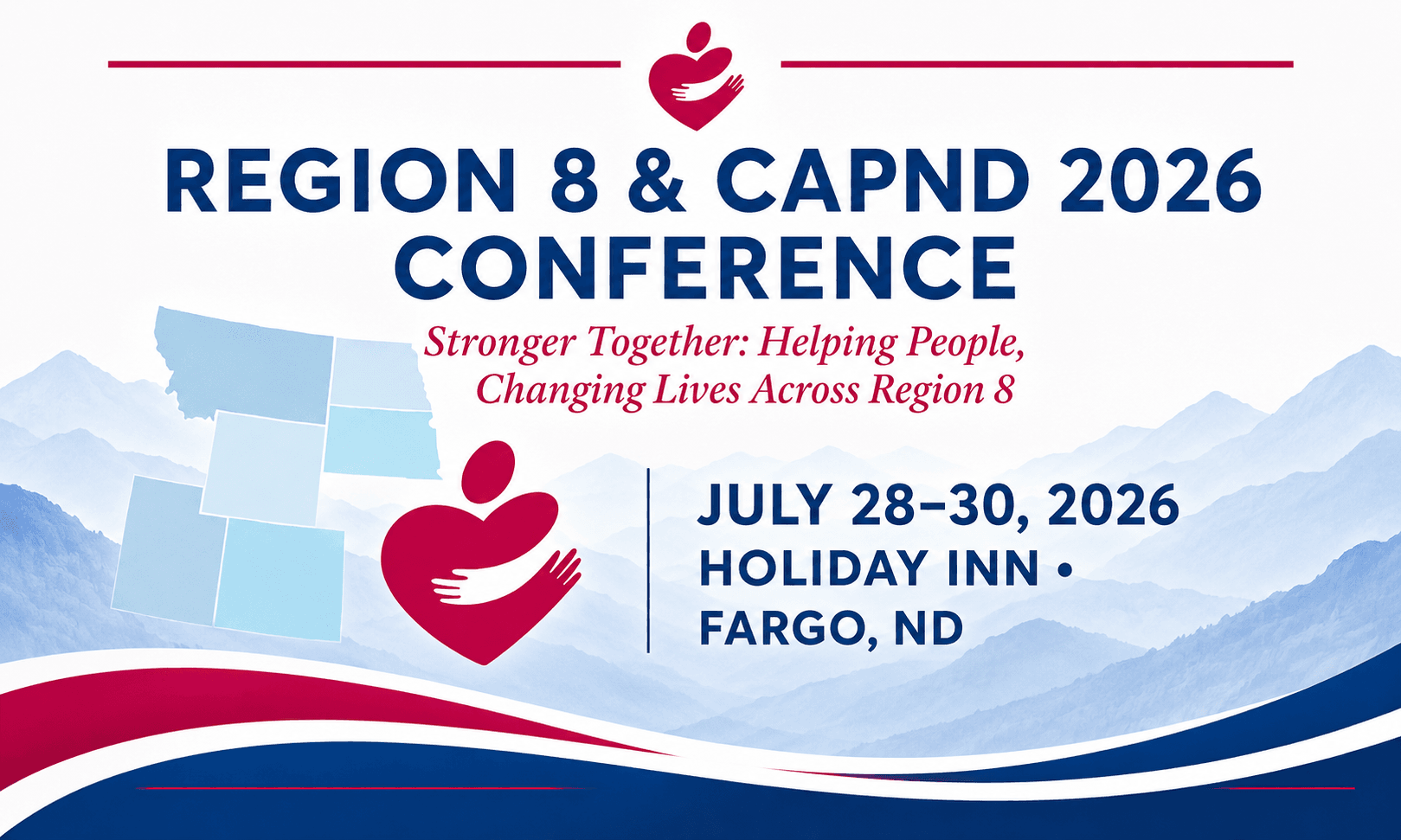
Stronger Together: Helping People, Changing Lives Across Region 8
July 28–30, 2026
Fargo Holiday Inn – 3803 13th Avenue South, Fargo, North Dakota
Community Action professionals from across North Dakota, South Dakota, Montana, Colorado, Utah, and Wyoming are invited to join us for the 2026 Region 8 & CAPND Conference.
This three-day event will bring together leaders, staff, state partners, and national experts to learn, connect, and strengthen our shared mission to reduce poverty and build thriving communities across the region.
Conference Agenda!
The agenda below reflects the spirit of this year's conference theme, Stronger Together: Helping People and Changing Lives Across Region 8. Over the course of two and a half days, Community Action professionals from all six Region 8 states (Colorado, Montana, North Dakota, South Dakota, Utah, and Wyoming) will come together to learn, collaborate, and share ideas that strengthen our work and our communities.
With more than 40 breakout sessions, the conference offers learning opportunities across a broad range of Community Action priorities, including Community Services Block Grant (CSBG), Weatherization, homelessness, fiscal management, leadership, governance, data, and program innovation. We are also honored to welcome our national partners, who will provide valuable federal updates, emerging best practices, and perspectives from across the Community Action Network.
We encourage you to review the agenda and personalize your conference experience by selecting the sessions that best align with your interests, responsibilities, and professional goals. We look forward to learning with you as we continue helping people and changing lives across Region 8!
Sessions marked with an asterisk (*) have been approved for Social Work Continuing Education Units (CEUs).
All Weatherization sessions have been approved for BPI credits.
Tuesday July 28, 2026
10:00-1:00 - Conference Opening and Keynote
-
Conference Opening and Keynote
Great Hall
All Attendees
Community Action professionals and partners from across South Dakota, North Dakota, Montana, Colorado, Utah, and Wyoming will come together to officially open the Region 8/CAPND Conference. The session will begin with welcoming remarks from Andrea Olson, Executive Director of Community Action Partnership of North Dakota, and Fargo Mayor Josh Boschee, followed by keynote speaker Doug Peters presenting From Carrying the Weight to Leading the Way. This inspiring and thought-provoking keynote will explore leadership, resilience, teamwork, and the important work of Community Action.
-
Federal and National Partner Updates
Great Hall
All Attendees
Verna Best and Mitch Navetta, Office of Community Services
Denise Harlow, National Community Action Partnership
Cheryl Williams, NASCSP
Savanna Arral, CAPLAW
Hear directly from Community Action’s Federal and National partners as they provide timely updates impacting agencies across the country. This session will highlight federal and national trends, policy developments, emerging opportunities, compliance considerations, and resources designed to strengthen Community Action work at the local level. Attendees will gain insight into the broader landscape shaping programs and services while connecting national priorities to day-to-day operations within Community Action Agencies.
-
Lunch Served
1:30-3:00 Breakout Sessions
-
Stronger Together: Leadership Perspectives Panel
Great Hall
Suggested for All Attendees
Fred Richmond, CAMP
Denise Harlow, National Community Action Partnership
Cheryl Williams, NASCSP
Susan Carr, CSNOW
Stefanie Jones, Utah CAP
Becky Saad, DOLA
Kristina Brownell, Region 8 Representative, NCAP Board of Directors
Erv Bren, Community Action Partnership of Dickinson/Williston
Marcia Erickson, GROW SD
Join Community Action leaders from across Region 8 and the Nation for a panel discussion focused on the challenges, opportunities, and emerging trends shaping Community Action work today. Panelists will share perspectives on leadership, innovation, workforce realities, partnerships, service delivery, and the evolving needs of the communities we serve. Through guided discussion and shared experiences, attendees will gain insight into how agencies across Region 8 are adapting, collaborating, and working together to strengthen Community Action for the future.
-
General Hazards in Weatherization
Harvest Hall Conference Room
Suggested for Weatherization workers, energy auditors, crew leads
Dave Gutterud, UND Environmental Training Institute
Covers the chemical and biological hazards weatherization workers are most likely to encounter in North Dakota residential work: asbestos-containing materials, lead-based paint, mold, and biological hazards including hantavirus and bat guano.
North Dakota-specific context is emphasized throughout. Vermiculite attic insulation and slate-look exterior siding are treated as assumed to contain asbestos under ND WAP rules, and the session explains exactly what that means for work practices — including the prohibition on blower door testing when friable ACMs are present inside the pressure boundary. Lead content addresses EPA RRP requirements (40 CFR Part 745) and HEPA cleanup requirements. Mold content focuses on recognizing conditions, protecting workers, and understanding when WAP rules require deferral rather than proceeding.
Participants leave knowing what to look for, what the rules require, when to stop work, and what documentation is needed.
-
CFM, ASHRAE, Misaligned Thermal Boundaries… oh my! Strategies for Communicating WX in an Understandable Way
Harvest Hall, Board Room
Suggested for Weatherization Attendees
Jake Nuckolls, Building Performance Center
The weatherization world is rife with insider speak, oddly specific language, and more acronyms than ASHRAE needs to complete a proper MVL. How do we as crews, inspectors, auditors, intake, admin and other staff communicate these complex concepts and ideas in a way that brings the homeowner into the process instead of alienating them or making their eyes glaze over? During this session, we'll look at a few ways to communicate large ideas simply as well as working together to create some new ways to address this age old issue.
3:00-3:30 Refreshment Break
3:30-5:00 Breakout Sessions
-
Complying with the HR and Financial Directives of the CSBG Organizational Standards
Harvest Hall, Directors Room
Suggested for Executive Directors, Agency Leadership, Board Members, HR, and Financial Directors and Staff
Savanna Arral, CAPLAW
This workshop will address the legal issues that CAAs face under the human resources and financial operations and oversight directives of the CSBG Organizational Standards (Categories 7 and 8). We will discuss how CAAs can proactively implement procedures and ensure appropriate recordkeeping to be able to document compliance with these standards, as well as how these procedures may fit within a CAA’s existing policies. This session will also cover working with attorneys and the CAA’s governing body to ensure that each participant in the process is familiar with its roles and responsibilities in meeting the standards.
-
Data in Practice: Roles, Routines and Culture *
Great Hall
Suggested for Executive Directors, Program Coordinators, Board Members, Agency Management, Data Practitioners.
This session is approved for 1.5 CEUs.
Maribeth Schneber-Rhemrev, CCAP, PMP, NCRT, National Community Action Partnership
Strong data capacity depends on more than technology—it requires accurate, complete, and well-integrated information that staff and leadership trust and use. This session explores how roles, routines, and leadership practices influence data quality and application, helping participants identify gaps, clarify responsibilities, and strengthen a culture where information reliably informs decisions and improves outcomes.
-
Innovative Ways States are Supporting Rural Agencies
Embassy A & B
Suggested for All Attendees
Hugh Poole and Lauren Johnson, NASCSP
Karen Quackenbush, Utah State Office
Lindsay Whittin, Tennessee State Office
What happens when states take a closer look at the everyday challenges of managing CSBG—especially for rural agencies and communities—and uncover practical solutions worth sharing? Over the past several years, NASCSP’s State Management Work Group 2.0 (SMWG 2.0) has explored that question, identifying promising state practices in three high-impact areas: Streamlined Administrative Procedures, Standardized Tools and Templates, and Specialized Rural Strategies. Join them for a lively panel discussion to hear about what they learned and what fresh ideas you can take back to your own network.
-
ROMA in Practice (Not Just Theory)
Harvest Hall, Executive Room
Suggested for Case Managers, HR, Executive Directors, Board Members
Fred Richmond, Center for Applied Management
Community Action Agencies are guided by ROMA principles and practices that support the delivery of services and strategies with the expectation of having a positive impact on the client, agency and community. This workshop will provide a guide and checklist for self-assessment to answer several fundamental questions: how well do we deliver services, and do we produce results?
-
Identifying Appliances isn’t the End of the World
Harvest Hall Board Room
Suggested for Weatherization Attendees
Jake Nuckolls, Building Performance Center
Combustion safety got you down? NFPA 54 makes as much sense as running ASHRAE calculations by hand? Having a hard time figuring out whether it’s a category 4 forced draft furnace or a category 3 natural draft boiler? This session will break down a variety of appliances, key components, and the differing ways to identify each.
-
Electrical Hazards in Weatherization
Harvest Hall Conference Room
Dave Gutterud, UND Environmental Training Institute
Suggested for Weatherization Attendees
Addresses the electrical hazards present on nearly every weatherization job, from residential service panels to extension cords and portable tools. Grounded in OSHA construction standards (29 CFR 1926.404) and practical field scenarios.
Content covers the physiology of electrical shock (why 75 milliamps — well below what most tools draw — can be lethal), the four types of electrical injury, job-site risk assessment, safe practices at circuit breaker panels, proper GFCI use and when it's required, extension cord selection and inspection, and PPE selection for electrical work. The session closes with emergency response: what to do — and what not to do — when a coworker is being shocked.
Participants leave able to conduct a basic electrical risk assessment, identify the most common hazardous conditions in older ND housing, and apply correct work practices around panels, cords, and live equipment.
5:00-6:00 CAPND Meeting with CAMP, Harvest Hall, Executive Room
6:00-7:30 Welcome and Networking Reception, All Attendees Welcome!
-
Stronger Together Begins with Building Connections!
Stronger Together begins with building connections!
All conference attendees, sponsors and vendors are welcome to join us in Sterling Crowne and Royale Room from 6:00-7:30 for a relaxed evening of networking and conversation with colleagues from across Region 8.
Complimentary hors d'oeuvres and beverages will be provided, and there is no cost to attend. Simply stop by, enjoy great company, and help us kick off a conference dedicated to helping people and changing lives.
We look forward to spending the evening with you!
Wednesday July 29, 2026
7:30-8:30 - Breakfast Served
8:30-10:00 Breakout Sessions
-
Data Walk: Exploring the Region 8's Data
Great Hall
Suggested for Executive Directors, Program Coordinators, Board Members, Agency Management, Data Practitioners
Maribeth Schneber-Rhemrev, CCAP, NCRT, National Community Action Partnership
Step into your data and see the story it tells through a hands-on data walk. Participants will move among interactive stations using Region 8’s real data to uncover patterns, raise questions, and explore meaning in collaboration with peers. Along the way, you’ll not only experience this engaging approach firsthand but also gain insight into how to design and host your own data walk back at your organization. This session turns analysis into an active, shared experience and offers fresh perspectives on the trends, successes, and challenges revealed by the data.
-
Social Return on Investment for Community Action *
Harvest Hall, Executive Room
Suggested for Executive Directors, Board Members, Program Coordinators, HR, and Administrative Staff.
This session is approved for 1.5 CEUs.
Fred Richmond, Center for Applied Management
All too often, the role and contribution of social service agencies to the greater good of the individual and community is not understood. SROI measures change in ways relevant to the people or organizations that experience or contribute to it, assigning monetary values to represent social, environmental, and economic outcomes. We are data collectors and can account for the delivery and impact of our services. Can we use this same data to tell a different story, that funding Community Action is a not only for a good cause but is a good investment as well?
-
Mental Health Foundations in Action *
Embassy A & B
Suggested for Frontline staff, Case Managers, Executive Directors, HR
This session is approved for 1.5 CEUs
Dr. Shellie Beeker, North Dakota State University
This program will give you awareness, information, and education on ways mental health concerns can present. In addition, we will discuss and explore when to refer to professional care, practical application and demonstration for supporting individuals who may be struggling with mental health concerns. Finally, the session will highlight the importance of engaging with our own mental and emotional well-being as supporters for others in need.
-
Root Causes, Real Lives: Understanding Social Determinants of Health in Community Action *
Harvest Hall, Directors Room
Suggested for Case Managers, HR, Program Directors, Board Members, and Executive Directors.
This session has been approved for 1.5 CEUs.
Dr. Jeremy Holloway, North Dakota Department of Commerce
Social Determinants of Health are the conditions in which people are born, live, learn, work, worship, and age. These conditions shape health, stability, opportunity, and well-being long before someone walks through the door for services.
This 90-minute breakout session will introduce Social Determinants of Health through a Community Action lens, connecting the framework to poverty, family stability, housing, transportation, food security, employment, education, safety, access to care, and community conditions. Participants will explore how SDOH can help agencies better understand client needs, strengthen referrals and linkages, support case management, inform needs assessments, and tell a more complete story about the work Community Action Agencies are already doing.
The session will be practical and discussion-based, with a focus on how staff, leaders, and partners can use SDOH concepts in everyday program planning, client support, data collection, and community collaboration.
-
Building Science Basics
Harvest Hall, Board Room
Suggested for Weatherization Attendees
Jake Nuckolls, Building Performance Center
Weatherization work is built around a proper understanding of building science, specifically energy movement. Knowing which way moisture will travel or why a drop soffit in a kitchen can cause heat flow issues is vital to the detective work of energy auditing. This session will introduce weatherization and building science principles including principles of heat, moisture, and air movement and how this affects the structure of the homes we work on.
-
Weatherization Injury Prevention
Harvest Hall Conference Room
Dave Gutterud, UND Environmental Training Institute
Suggested for Weatherization Attendees
Covers the primary physical injury risks in weatherization work: falls, confined space entry, respiratory hazards, and heat-related illness. Organized around OSHA's Fatal Four, with content tied directly to weatherization job conditions rather than general construction.
Fall content covers the hierarchy of fall hazard controls, personal fall arrest system components and inspection, suspension trauma and the rescue requirement that most workers don't know about, and ladder safety. Confined space content addresses how to recognize when a crawl space or attic becomes a permit-required space and what to do when a worker experiences symptoms inside. Respiratory protection covers respirator selection, the difference between a dust mask and a NIOSH-approved N-95, and medical and fit testing requirements under 29 CFR 1910.134. Heat stress content distinguishes heat exhaustion from heat stroke and covers prevention strategies for attic and summer work.
Participants leave with practical knowledge they can apply on the next job, not general safety theory.
10:00-10:30 Refreshment Break
10:30-12:00 Breakout Sessions
-
Supervisor Basics Including Delegating, Managing Peers, and Accountability
Great Hall
Suggested for Executive, Leadership and Management staff, HR, Board Members
Susan Williams, The Village Family Service Center
This session will provide a practical refresher and skill-building opportunity for supervisors. Topics will include the responsibilities of a supervisor, qualities of effective supervision, the importance of building trust between supervisors and staff, and three selected focus areas: delegation, managing peers, and accountability.
-
Mental Health Foundations in Action (Repeat Session) *
Embassy A & B
Suggested for Frontline staff, Case Managers, Executive Directors, HR
This session is approved for 1.5 CEUs
Dr. Shellie Beeker, North Dakota State University
This program will give you awareness, information, and education on ways mental health concerns can present. In addition, we will discuss and explore when to refer to professional care, practical application and demonstration for supporting individuals who may be struggling with mental health concerns. Finally, the session will highlight the importance of engaging with our own mental and emotional well-being as supporters for others in need.
-
Becoming a Data-Driven Community Action Agency *
Harvest Hall, Executive Room
Suggested for All Attendees
This session is approved for 1.5 CEUs
Fred Richmond, Center for Applied Management
Data-drivenness is about building tools, abilities, and, most crucially, a culture that acts on data…….Carl Anderson”. CAAs are competent data collectors usually in compliance with third party reporting requirements. How do we turn this data into information that can be applied to the management of the agency? In this workshop we will introduce an 11 step program for establishing processes that support service delivery, accountability and measuring success.
-
Trust but Verify: The Board and Managements’ Roles in Internal Controls and Financial Transparency
Harvest Hall, Directors Room
Suggested for Executive Directors, Fiscal Directors, Board Members, and HR
Ashley Engel and Jeremy Ulmer, Brady Martz
Strong financial oversight is a shared responsibility between nonprofit management, governing boards, and external auditors. This session will explore the distinct roles each plays in maintaining sound internal controls, financial transparency, and organizational accountability. Presenters will discuss the audit process, including the responsibilities of management and auditors, and share practical internal control strategies that can be implemented by organizations of all sizes. Attendees will learn how to identify potential red flags in financial reports, understand key indicators of organizational financial health, and gain insight into the concept of going concern. The session will also provide an overview of the Form 990, including what board members should know, how it tells the story of an organization, and opportunities to strengthen that narrative. Finally, participants will receive guidance on responding to single audit findings and using them as opportunities for continuous improvement.
-
Introduction to Healthy Housing and the Keep-It Principles
Harvest Hall Board Room
Suggested for Weatherization Attendees
Jake Nuckolls, Building Performance Center
Home assessments often focus on energy savings, but increasingly we are asked to pay attention to the health of the home and the occupants. This session will begin preparing home energy professionals to assess and characterize home based environmental health and safety hazards by integrating observations with diagnostics. All based on the nationally recognized “keep-it” principles.
-
Radon Awareness in Weatherization
Harvest Hall Conference Room
Dave Gutterud, UND Environmental Training Institute
Suggested for Weatherization Attendees
Provides weatherization workers with a working understanding of radon: what it is, how it enters buildings, why it matters in North Dakota, and what WAP rules allow them to do about it.
North Dakota is entirely within EPA Radon Zone 1 — the highest-risk designation — and radon is the leading cause of lung cancer among non-smokers nationally. Because weatherization tightens the building envelope, it can increase indoor radon concentrations if entry points are not addressed. The session explains why, what precautionary measures are allowable under DOE WPN 17-7 (vapor barrier installation, sealing foundation penetrations, covering sump pits), and what is not allowable (mitigation systems, testing as a WAP activity). Client education and informed consent requirements specific to North Dakota are covered in detail, including the requirement for a signed consent form on every ND WAP job regardless of whether testing has been conducted.
Participants leave understanding the ND-specific radon risk, what they can and cannot do under WAP, and how to have an informed conversation with clients about mitigation options.
12:00 Lunch with Friends of Community Action Awards and Staff Recognitions
1:30-3:00 Breakout Sessions
-
Personal Wellness and Self Care: Time Mastery *
Great Hall
Suggested for Executive, Leadership and Management staff, HR, Board Members
This session is approved for 1.5 CEUs
Susan Williams, The Village Family Service Center
Supporting healthy lifestyles and encouraging employees to be proactive in caring for themselves contributes to a healthier, more productive workplace. When your “to-do” list is longer than your available time, how do you manage the challenge?
This session will address common time management myths, explore strategies to help participants better manage their schedules, and provide practical tips for overcoming procrastination.
-
Affordable Housing Trends in North Dakota
Embassy A & B
Suggested for All North Dakota Attendees
Jennifer Henderson, North Dakota Housing Finance Agency
North Dakota Housing Finance Agency (NDHFA) will present findings and data trends from its statewide housing studies and research initiatives focused on housing affordability, availability, population trends, and projected housing needs across North Dakota. This session will explore current market conditions, barriers impacting homeowners and renters, regional housing challenges, and emerging trends affecting communities throughout the state. Attendees will gain valuable insight into housing data, planning tools, and statewide trends that can help inform local decision-making, community development efforts, and future housing strategies.
-
The Accountable Case Manager *
Harvest Hall, Executive Room
Suggested for Case Managers and Direct Service Workers
This session is approved for 1.5 CEUs
Fred Richmond, Center for Applied Management
This workshop for case managers and direct service workers identifies the basic skills and practices necessary to be successful in their job. It explores the economics of insufficiency and scarcity, its impact on clients and organizations, the importance of front line staff, and offers a replicable model for client/case management that can demonstrate outcomes and organizational effectiveness.
-
Fiscal Budgeting and Reporting in the MIP Fund Accounting Software
Harvest Hall, Directors Room
Jennifer Mueller, Southeastern North Dakota Community Action
Suggested for Fiscal staff who utilize the MIP software.
MIP offers powerful budgeting and reporting tools that can streamline financial management and reduce reliance on spreadsheets. In this session, Jennifer Mueller will share practical strategies for maximizing the MIP Budget Module based on nearly a decade of experience using the software for forecasting, budgeting, and financial reporting at both CAPND and SENDCAA. Participants will explore ways to make MIP work harder for them, learn how to improve efficiency through built-in budgeting features, and identify tasks currently being performed in Excel that could be automated or simplified within MIP. Whether you are new to the Budget Module or looking to get more out of your existing system, this session will provide practical tips to enhance your financial management processes.
-
The Adventure of Weatherizing Mobile Homes
Harvest Hall Board Room
Suggested for Weatherization Attendees
Jake Nuckolls, Building Performance Center
It’s an understatement to say that mobile homes are not like stick built homes. They are full of unique constructions, layouts, and materials. Weatherizing mobile homes requires additional information and awareness. This session will cover basics and provide a foundation of information to understand how to weatherize a mobile home.
-
Statewide Needs Assessment and Indoor Environmental Quality (IEQ): Trends, Challenges, and Opportunities in North Dakota
Harvest Hall, Conference Room
Suggested for North Dakota Weatherization Attendees
Dr. Yao Yu, North Dakota State University
This session presents findings from statewide needs assessments conducted in 2020, 2023, and 2026 in North Dakota, with a focus on trends and priorities related to Indoor Environmental Quality (IEQ). Because people spend approximately 90% of their time indoors, IEQ plays a major role in occupant health, comfort, well-being, and productivity. IEQ includes indoor air quality (IAQ), lighting, acoustics, and thermal comfort, with IAQ being especially important due to its direct impact on health. Poor IAQ has been linked to respiratory illnesses, allergies, asthma, carbon monoxide exposure, and Sick Building Syndrome (SBS), and may also negatively affect cognitive performance and learning outcomes.
The session will introduce key IEQ and IAQ concepts and relevant standards and guidance (e.g., ASHRAE Standards 62.2 and 55, and EPA guidance), followed by a summary of statewide survey findings highlighting regional differences and how IEQ concerns have evolved over time. The presentation will also discuss practical approaches for improving IEQ while maintaining energy efficiency through HVAC optimization, building energy modeling, and data-driven operational strategies. The goal of this session is to provide practical and actionable insights that support healthier, safer, and more sustainable indoor environments across North Dakota communities.
3:00-3:30 Refreshment Break
3:30-5:00 Breakout Sessions
-
Transparent Communication *
Great Hall
Suggested for Executive, Leadership and Management staff
This session is approved for 1.5 CEUs
Susan Williams, The Village Family Service Center
Transparent communication is essential to building trust, strengthening workplace relationships, and creating a more engaged and positive work environment. When employees understand expectations, decisions, and organizational direction, they are better equipped to contribute with confidence and clarity.
This session will help participants understand what transparent communication is, why it matters in the workplace, and how leaders and teams can create a more open, honest, and transparent working environment.
-
HUD’s Strategic Objectives and Actions by HUD Priority
Embassy A & B
Suggested for Executive, Leadership and Management staff, Board Members
Dedra Carey, HUD
This session will provide attendees with an overview of HUD’s FY2026 strategic objectives and how they align with current Administration priorities, including reducing barriers to affordable housing, reducing homelessness, protecting taxpayer funds, and streamlining business processes. Participants will also receive updates from the HUD Region 8 Program Office, hear about federal partnerships and initiatives, and learn more about HUD’s customer resource management approach and available technical assistance supports. This presentation will offer valuable insight into federal priorities, collaborative efforts, and resources available to support housing and community development work across the region.
-
Doing More With What You Already Have
Harvest Hall, Conference Room
Suggested for Executive Directors, Management Staff, Board Members, Frontline Staff, Data Practitioners.
Mac Berns, Absolute Studios
How Small Teams Can Turn Existing Stories, Reports, and Program Successes Into Year-Round Communications.
-
From ROMA Reporting to Modern Storytelling *
Harvest Hall, Executive Room
Suggested for Executive, HR, Fiscal Directors, Case Managers and Direct Service Workers, Board Members
This session is approved for 1.5 CEUs
Fred Richmond, Ben Richmond Center for Applied Management
Community Action has always had powerful stories to tell. Through the ROMA framework, agencies have spent decades collecting data, measuring outcomes, and demonstrating accountability. This session explores how to build on that foundation by using business intelligence, data visualization, artificial intelligence, and modern communication strategies to transform data into meaningful stories. We'll look beyond traditional annual and compliance reports to create dashboards, infographics, presentations, social media, websites, videos, and outreach campaigns that support your mission and vision. Whether you're using Excel and ChatGPT or platforms like Power BI, Tableau, or Domo, you'll learn practical ways to make your data more accessible, strengthen relationships with funders and community partners, expand public awareness, and turn information into action that drives lasting community impact.
-
Early Retirement Conversations: Build Employee Confidence with a Retirement Readiness Check-in
Harvest Hall, Directors Room
Suggested for Board Members, Executive Directors, Fiscal Directors, and HR
Jerry Bruzek and Nick Fletcher, Mutual of America
Planning for retirement involves more than simply choosing a retirement date. This session explores key considerations for employees planning for retirement, including Social Security timing, healthcare and Medicare, income planning, retirement savings strategies and the financial impact of retiring earlier than expected. Attendees will walk away with practical tools and insights to help evaluate overall financial readiness and build confidence in their retirement planning journey.
-
Weatherization Field Resources: The House Depressurization Chart
Harvest Hall Board Room
Suggested for Weatherization Attendees
Jake Nuckolls, Building Performance Center
There are many tools that exist thanks to the work of giants in the industry. A variety of field tools that can be used to determine airflow, depressurization, CFM, intermittent airflow. This session focuses on how to properly use the depressurization chart, but also others that are extremely helpful in day to day diagnosis.
6:00-9:00 Fargo-Moorhead Redhawks Baseball Game!
-
Advance RSVP Required!
The Region 8 Community Action Association welcomes you to join us for an evening at the FM Redhawks baseball game as we celebrate Community Action together!
The Surfside Patio has been reserved exclusively for conference attendees.
Your complimentary ticket includes access to the exclusive deck and a two-hour all-you-can-eat buffet!
Gates open at 6:00 pm and the game begins at 7:02 pm.
Food is served from 6:00 pm-8:00 pm! Pepsi products, water, and lemonades will be available for purchase until the 7th inning.
If you haven't already RSVP'd to attend the game, please contact Andrea Olson at andreao@capnd.org.
RSVPs are due no later than July 10.
Thursday July 30, 2026
7:30-8:30 - Breakfast Served
8:30-10:00 Breakout Sessions
-
Conversations on Access to Lethal Means *
Great Hall
Suggested for All Attendees
This session is approved for 1.5 CEUs
Sarah Kemp-Tabbut, University of North Dakota
Many people do not access behavioral or physical health care despite having thoughts of or being at risk of suicide. Yet many of them signal to others – directly or indirectly – that they are struggling. This workshop is designed to provide friends, family and others with information on how recognize and respond to suicide risk with an additional focus on reducing access to lethal means – especially firearms. Participants learn how to talk with someone who might be having these thoughts in a collaborative, non-judgmental and supportive manner. CALM Conversations is divided into four sections. In Section 1, participants learn basic facts and misconceptions about suicide, common risk factors and warning signs, and the importance of means safety in keeping at-risk individuals safe. In Section 2, participants learn to ask about mood and suicide, with opportunities to practice asking questions in their own words. Section 3 focuses on connecting at-risk individuals to both formal and informal sources of support. Section 4 focuses on discussing means safety and making the environment safer for the at-risk individual until their mood state improves. CALM Conversations is intended for a general audience and requires no prior training in mental health or suicide prevention. The workshop is 90 minutes in length.
-
Motivational Interviewing *
Embassy A&B
Suggested for frontline staff, case managers, HR
This session is approved for 1.5 CEUs
Sara Wiederholt, Veterans Administration Medical Center
This interactive training offers an introduction to the foundational principles of Motivational Interviewing (MI), a client-centered communication style designed to strengthen an individual's own motivation and commitment to change. The training also includes practical tips for integrating MI techniques into daily work with clients, even in brief interactions. This session will equip participants with tools to better support behavior change in a respectful and effective manner by meeting them where they are at in their current stage of change and helping to elicit motivation to change.
-
National Alliance for Mental Health Smarts for Advocacy *
Harvest Hall, Executive Room
Suggested for Frontline Staff, Case Managers, Management, Executive Directors, Board Members
This session is approved for 1.5 CEUs
Madison Hanson, National Alliance for Mental Health Smarts for Advocacy
NAMI Smarts for Advocacy is an interactive advocacy training that teaches individuals and families affected by mental health conditions how to effectively share their stories, engage with policymakers, and advocate for policies that improve mental health care and support services. Participants will gain practical tools and skills to become confident, informed advocates for change.
By the end of the training, participants will be able to:
- Explain key components of the policymaking process.
- Develop and deliver an effective personal advocacy story.
- Communicate persuasively with policymakers and stakeholders.
- Identify advocacy opportunities related to mental health issues.
- Take concrete actions to advance mental health policy and systems change. -
Uniform Guidance - Part One of Two
Harvest Hall, Directors Room
Suggested for Management, Executive Directors, Board Members, Fiscal Directors, HR, Administrative Staff, Program Directors
Kevin Myren, CPA
Two (2) break-out sessions focusing on recent changes and key components of the OMB Uniform Guidance.
-
Weatherization Crew Peer Exchange and Learning
Harvest Hall, Board Room
Suggested for Weatherization Crew Members Only
Norris Elshaug, Dakota Prairie Community Action
This roundtable is a focused opportunity for crew members to discuss what they need to be successful in their roles. It’s a chance to share positive strategies, solutions, and techniques that help improve efficiency and job satisfaction. We’ll explore the importance of understanding program goals, meeting performance targets, and why it’s crucial to complete jobs on time.
We’ll engage in open dialogue to help crew members understand the bigger picture, from meeting averages to having a personal stake in the success of each project. This is a solutions-oriented discussion aimed at enhancing teamwork and ensuring we’re all aligned in achieving our goals.
-
Weatherization Foremen Peer Exchange and Learning
Harvest Hall, Conference Room
Suggested for Weatherization Foremen Only
Matt Igard, Community Action Partnership Regions 1 and 8
This roundtable provides Weatherization foremen with an opportunity to connect with peers from across the region to discuss leadership in the field, crew management strategies, production expectations, communication, and day-to-day jobsite realities. Foremen play a critical role in balancing quality work, safety, efficiency, and team morale while helping crews stay on track and meet program goals. This session is designed to encourage open discussion around practical solutions, successful leadership approaches, and techniques that help crews operate effectively in the field. Participants will have the opportunity to share challenges, discuss what is working well in their agencies, and learn from one another in a collaborative, solutions-oriented environment focused on strengthening Weatherization teams across the network.
10:00-10:30 Refreshment Break
10:30-12:00 Breakout Sessions
-
Conversations on Access to Lethal Means (Repeat Session) *
Great Hall
Suggested for All Attendees
This session is approved for 1.5 CEUs
Sarah Kemp-Tabbut, University of North Dakota
Many people do not access behavioral or physical health care despite having thoughts of or being at risk of suicide. Yet many of them signal to others – directly or indirectly – that they are struggling. This workshop is designed to provide friends, family and others with information on how recognize and respond to suicide risk with an additional focus on reducing access to lethal means – especially firearms. Participants learn how to talk with someone who might be having these thoughts in a collaborative, non-judgmental and supportive manner. CALM Conversations is divided into four sections. In Section 1, participants learn basic facts and misconceptions about suicide, common risk factors and warning signs, and the importance of means safety in keeping at-risk individuals safe. In Section 2, participants learn to ask about mood and suicide, with opportunities to practice asking questions in their own words. Section 3 focuses on connecting at-risk individuals to both formal and informal sources of support. Section 4 focuses on discussing means safety and making the environment safer for the at-risk individual until their mood state improves. CALM Conversations is intended for a general audience and requires no prior training in mental health or suicide prevention. The workshop is 90 minutes in length.
-
CSBG and Community Linkages
Embassy A&B
Suggested for Executive Directors, Board Members, Program Directors and Administrators, HR
Susan Carr, NCRT, CSNOW Executive Director
Linkages are a cornerstone of the Community Services Block Grant (CSBG) framework, helping Community Action Agencies build meaningful partnerships that strengthen services, expand resources, and improve outcomes for individuals and families. This session will explore what linkages are, how they can be both formal and informal, and why they are essential to effective community action planning.
Participants will learn how strong linkages can inform annual community needs assessments and Community Action Plans while demonstrating impact to boards, funders, and policymakers. Through real-world examples, attendees will discover practical strategies for developing partnerships with traditional and nontraditional stakeholders, including schools, healthcare providers, employers, housing organizations, faith communities, and local businesses. The session will also challenge participants to think beyond conventional partnerships and identify innovative opportunities to create new connections that benefit agencies, communities, and the people they serve.
Whether you are looking to strengthen existing relationships or build new ones, this session will provide actionable ideas to help your agency leverage linkages as a powerful tool for community change. -
Uniform Guidance - Part Two of Two
Harvest Hall, Directors Room
Suggested for Management, Executive Directors, Board Members, Fiscal Directors, HR, Administrative Staff, Program Directors
Kevin Myren, CPA
Two (2) break-out sessions focusing on recent changes and key components of the OMB Uniform Guidance.
-
The SWS, what is it? What’s in it?
Harvest Hall, Conference Room
Suggested for North Dakota Weatherization Attendees
Alyssa Kroshus-Helling, North Dakota Department of Commerce
In this session, we’ll explore the Standard Work Specification- Aligned Field Guide . We will review how it can help guide the Weatherization work we do to ensure quality and effectiveness. By the end of this session, you’ll have a clear understanding of contents within the SWS, and how it plays a pivotal role in achieving our mission in serving low-income families through Weatherization.
-
Weatherization Estimator Peer Exchange and Learning
Harvest Hall, Board Room
Suggested for Weatherization Estimators Only
Jerry CAP, Community Action Partnership Region 6
This roundtable is a valuable opportunity for estimator staff to connect, share experiences, and discuss best practices for foundational work, basements, and other key weatherization techniques. We’ll explore methods for tackling common challenges and look at creative solutions to deal with rising material costs. This session is designed for peer-to-peer learning and collaboration; a chance to support each other in finding practical solutions. Come prepared to share what’s working in your region, learn from others, and leave with fresh ideas to enhance your estimating process moving forward.
12:00 End of Conference
12:30-3:30 Region 8 Association Board of Directors Annual Meeting, Executive Room (lunch provided for Board Members)
Conference and Sponsorship Opportunities!
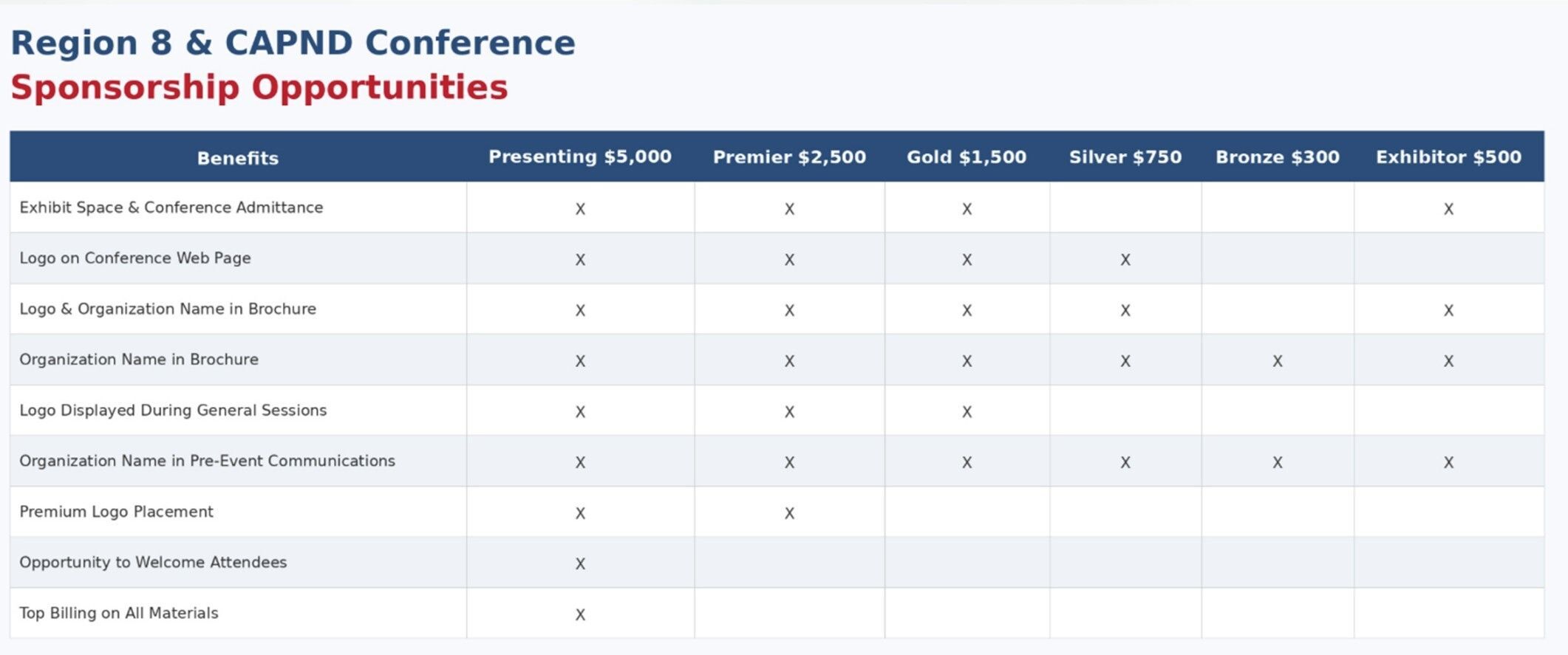
The Region 8 & CAPND Conference brings together Community Action leaders, program staff, board members, and partners from across the region. Sponsorship and exhibitor opportunities provide meaningful visibility while directly supporting training, collaboration, and capacity-building efforts that strengthen services for low-income individuals and families.
Thank You to Our Sponsors!